
Cleaning your home can feel productive even when you are simply moving from one task to another. But there is a hidden problem with cleaning randomly: the order you clean can affect how clean your home actually becomes. Dust can fall onto freshly cleaned surfaces, dirty water can spread grime, and vacuuming too early can leave you cleaning the same floors twice.
A better cleaning routine is not necessarily about doing more. It is about doing tasks in a smarter order.
For homeowners looking for House Cleaning Plano TX, understanding the right cleaning sequence can also help you get more out of every professional or DIY cleaning session. Whether you are maintaining your home weekly or preparing for a deeper cleaning, the order matters.
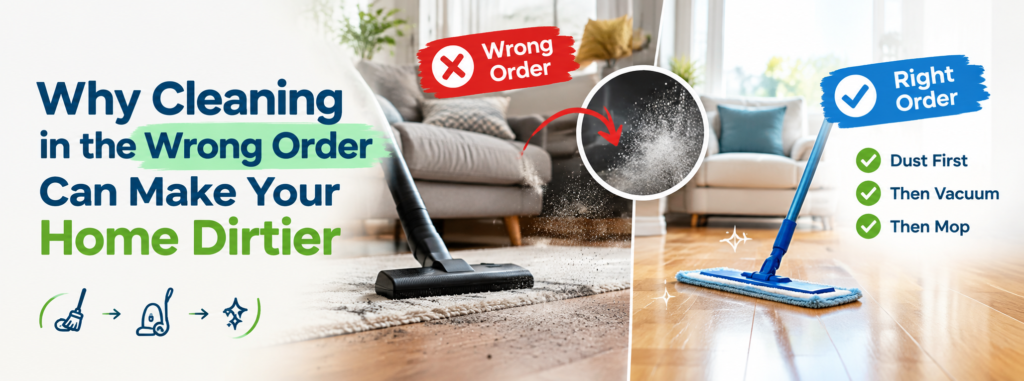
Why Cleaning Order Matters
Most cleaning tasks create some type of movement.
Dust gets lifted into the air. Crumbs fall from counters. Cleaning solutions drip. Furniture gets moved. Floors collect debris while other areas are being cleaned.
If you clean a surface before completing the messier task above or around it, you may have to clean that same area again.
For example, imagine wiping down your kitchen counters and then cleaning the dusty cabinet tops directly above them. Dust and debris can fall onto your freshly wiped counters.
You did not clean incorrectly. You simply cleaned in an inefficient order.
This is one reason professional Plano cleaning services generally follow a logical sequence rather than jumping between unrelated tasks.
Start High and Work Your Way Down
One of the simplest rules for cleaning is to work from higher surfaces toward lower ones.
Begin With Higher Surfaces
Start with areas such as:
- Ceiling fans
- Light fixtures
- High shelves
- Cabinet tops
- Picture frames
- Tall furniture
These areas often collect dust that can fall downward when disturbed.
Finish With Lower Surfaces
Once higher surfaces are finished, move toward:
- Tables
- Counters
- Furniture
- Baseboards
- Floors
This prevents you from cleaning the same area repeatedly.
If you are searching for a maid service Plano TX, this top-to-bottom approach is one of the basic principles worth looking for in a thorough cleaning routine.
Dust Before You Vacuum
Vacuuming first may seem logical because floors often look like the dirtiest part of a room. However, dusting afterward can undo some of your work.
When you dust shelves, furniture, or other surfaces, particles can fall onto the floor.
That means the better sequence is usually:
Dust → clean surfaces → vacuum → mop
Vacuuming near the end allows you to collect the debris that has fallen during the rest of the cleaning process.
This can be especially useful during deep cleaning Plano TX, when more surfaces are being disturbed than during a quick maintenance clean.
Clean One Room With a Purpose
Another common mistake is constantly moving around the house without finishing a task.
You might wipe a bathroom mirror, walk into the kitchen to grab a product, notice the countertop needs attention, then move into the living room because something else catches your eye.
Before long, you have touched several rooms without fully completing any of them.
Instead, establish a cleaning flow.
For example:
- Remove clutter.
- Dust higher surfaces.
- Clean surfaces.
- Clean glass and mirrors.
- Vacuum.
- Mop.
- Move to the next room.
This creates less backtracking and makes it easier to see your progress.
Don’t Mop Before the Messy Work Is Done
Few things are more frustrating than mopping a floor and then immediately getting it dirty again.
Moving furniture, wiping cabinets, cleaning appliances, or emptying trash can create new debris.
That is why floors are usually best left toward the end of the cleaning process.
Think of the Floor as the Final Collection Point
Throughout the cleaning process, dust, crumbs, hair, and other particles naturally make their way downward.
Your floor essentially becomes the collection point for everything you have removed from other surfaces.
Vacuuming and mopping near the end allows you to remove that buildup all at once.
This is particularly important for residential cleaning Plano homes where regular maintenance can help prevent dirt from becoming deeply embedded in flooring.
Use Cleaner From Cleanest Areas to Dirtiest Areas
Not every surface carries the same amount of grime.
Bathrooms, kitchen surfaces, entryways, and frequently touched areas can require more attention than relatively clean decorative surfaces.
Moving from cleaner areas toward dirtier ones can help reduce the chance of spreading grime from one area to another.
It is also important to use appropriate cloths and cleaning tools for different areas. A cloth used on a heavily soiled surface should not automatically be reused on a clean countertop.
Good cleaning is not only about removing dirt. It is also about avoiding the unnecessary transfer of dirt.
Don’t Forget High-Touch Surfaces
A room can look clean while frequently touched areas are still being overlooked.
Think about the surfaces your household interacts with throughout the day:
- Door handles
- Light switches
- Cabinet handles
- Appliance handles
- Remote controls
- Faucet handles
- Stair railings
These areas deserve regular attention because they are touched repeatedly.
During a more detailed cleaning, including these surfaces can make the home feel noticeably fresher without requiring hours of additional work.
Why Random Cleaning Takes Longer
Cleaning in the wrong order can create something called rework.
Rework simply means having to repeat something because a later task made the earlier work less effective.
For example:
Wrong order:
Mop → dust furniture → move furniture → vacuum → mop again
Better order:
Declutter → dust → clean surfaces → move furniture → vacuum → mop
The second approach reduces unnecessary repetition.
That is one reason professional cleaning can sometimes look effortless. A trained cleaning team is not just wiping and vacuuming. They are following a process designed to minimize wasted movement.
Where Deep Cleaning Requires Even More Planning
A standard cleaning routine is easier to manage because you are usually maintaining surfaces that are already relatively clean.
A deep cleaning Plano TX service is different.
Deep cleaning may involve areas that are not part of every weekly routine, such as:
- Behind and underneath furniture
- Baseboards
- Cabinet interiors
- Detailed bathroom surfaces
- Hard-to-reach corners
- Light fixtures
- Doors and trim
- Appliance exteriors
Because more areas are being addressed, the sequence becomes even more important.
A good deep-cleaning process should prevent completed areas from becoming dirty again as other tasks are performed.
What About Move-In and Move-Out Cleaning?
Cleaning order becomes especially important when a home is empty.
For move out cleaning Plano, for example, cleaning inside cabinets and closets before completing the floors makes sense because debris can fall onto the floor afterward.
The same principle applies to move in cleaning Plano TX.
Before bringing furniture and boxes into a new space, cleaning from top to bottom can help ensure that dust and debris are removed before the home becomes difficult to access.
An empty home also provides an opportunity to reach areas that are normally hidden by furniture.
Commercial Spaces Need the Same Strategy
The same cleaning principles apply outside the home.
In office cleaning Plano TX and commercial cleaning Plano, cleaning in a logical sequence can help reduce interruptions and unnecessary repetition.
For example, dusting desks before vacuuming the surrounding floors makes more sense than vacuuming first and then knocking dust and debris onto the floor.
In busy commercial environments, an efficient cleaning order can also help teams complete their work while minimizing disruption to employees and customers.
Don’t Let Cleaning Products Determine the Entire Routine
Another common mistake is assuming that because a cleaning product is effective, it should be used everywhere.
Different materials can require different cleaning methods.
Wood, stone, glass, stainless steel, painted surfaces, and fabrics may not respond the same way to a particular cleaner.
Always follow the product label and the manufacturer’s care instructions for specialty surfaces.
The goal is not to use the strongest cleaner possible. The goal is to use an appropriate method for the surface and the type of dirt being removed.
A Simple Cleaning Order to Remember
If you are not sure where to begin, keep the basic sequence simple:
1. Declutter
Remove items that do not belong in the space.
2. Work From High to Low
Dust fans, shelves, furniture, and other elevated surfaces first.
3. Clean Surfaces
Wipe counters, tables, appliances, and other appropriate surfaces.
4. Handle Glass and Mirrors
Complete windows, mirrors, and other glass surfaces before finishing the floors.
5. Vacuum
Remove dust, hair, crumbs, and debris from floors and upholstery as appropriate.
6. Mop
Finish hard floors after the majority of dry debris has been removed.
7. Check the Room
Take a final look for missed spots, streaks, or areas that need a quick touch-up.
This simple system can make cleaning feel much more organized.
When Professional Cleaning Makes Sense
Sometimes the issue is not knowing how to clean. It is finding enough time to do everything properly.
A professional cleaning company Plano TX can take over the repetitive work while following an organized cleaning process.
Professional cleaning may be especially useful when you are preparing for guests, managing a busy household, moving, recovering from a particularly messy week, or simply trying to keep your home consistently maintained.
For specialized needs, services such as carpet cleaning Plano TX or post construction cleaning Plano may also require different tools and procedures than routine house cleaning.
The important thing is to match the cleaning method to the condition of the property.
A Cleaner Home Starts With a Smarter Sequence
Cleaning more does not always mean cleaning better.
If you clean floors before dusting, wipe counters before cleaning the cabinets above them, or repeatedly move between rooms without a plan, you may create extra work for yourself.
A logical cleaning order helps prevent that.
Start high. Work downward. Complete the messier tasks before finishing the floors. Keep cleaner and dirtier areas separate, and save the final floor cleaning for the end.
Whether you are maintaining your home yourself or working with House Cleaning Plano TX professionals, a smart sequence can make the entire process more efficient — and help your home stay cleaner for longer.
For homeowners who want a consistent, organized approach to keeping their spaces fresh, Walo Maids is here to help make cleaning one less thing to worry about.
Contact us at 214–390–3387 or visit https://walomaids.com/plano-tx-house-cleaning-and-maid-service/ to book your service.